
The authority and the service context
Pakistan Halal Authority’s official material describes its halal regulatory role and publishes registration and certification information. The supplied Halal360 manuals provide the staff-side workflow detail used in this case. Registration, assessment and ongoing oversight are related activities, but each application stream retains its own stage configuration.
Context reference: Official client context
Four application streams in one operating model
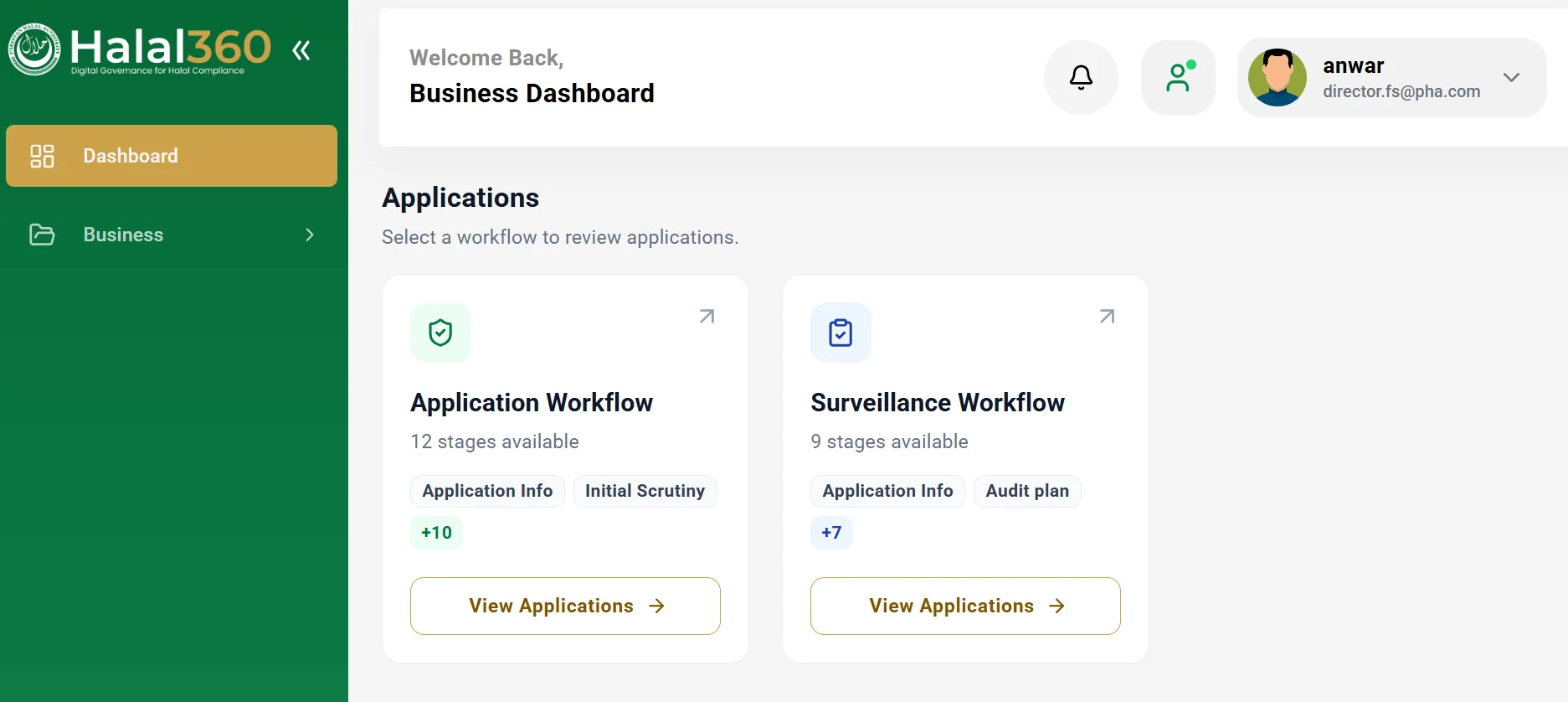
The four PHA Business Portal manuals document food service provider registration, halal logo authorization, halal certification body registration and slaughterhouse registration. The supplied interface identifies the portal as Halal360.
The Applicant Portal receives applications and responses. PHA staff process them in the Business Portal, while administrators configure users, groups, menus, workflows, checklists, letters and fees in the Admin Portal.
From allocation to scrutiny
A receiving or focal officer allocates the application to the responsible officer. Scrutiny uses configured checklists and may lead to a shortcoming notice or a request for additional documents. Applicant responses return to the processing workflow.
The manuals explain that access follows administrator-configured user groups and stage permissions. Stage labels and available actions therefore depend on configuration rather than one fixed role list.
Audit, inspection and laboratory work
The process supports audit planning and approval, physical inspection, evidence recording and review. Sample collection, laboratory payment advice, test requests and conformance decisions appear in the relevant workflows.
The exact stage sequence differs between the registration and authorization streams. The case study therefore describes the common operating pattern without assigning one stream’s stage count to every application.
Issuance and continuing oversight
Reviewers and approval authorities act on recommendations before authorized certificate issuance. The same portal supports renewal, surveillance cycles, additional-document activities and shortcoming correspondence after certification.
Application trails, note sheets, messages, notifications and reports provide visibility of processing activity. Certification decisions remain with the responsible authority; operating the software does not confer certification on its buyer.
A documented workflow reference
These manuals establish the staff workflows and connected portal responsibilities. They do not establish processing volumes, national coverage, implementation dates or a measured approval-time improvement.
A similar regulatory portal should agree application types, stage ownership, checklists, inspection evidence, certificate templates, laboratory handoffs and post-issuance responsibilities before implementation.
ERP and mobile application work order
The February 2026 work order records design, development and implementation of an ERP solution and mobile application for Pakistan Halal Authority. It establishes commissioned scope and does not by itself confirm completion of every module.
Following a request beyond initial approval
The manuals cover application intake and staff allocation, then describe scrutiny, evidence gathering and review activities. Issuance is followed by continuing oversight in the relevant streams, including renewal or surveillance. This makes the case a continuing regulatory workflow rather than a one-time application form.
For a similar portal, review should include an application returned for missing information, an inspection or laboratory handoff where applicable, and a post-issuance activity. The configured stage permissions and the authority’s decision responsibilities should remain clear at every step. The software records and supports the process; the certification decision belongs to the responsible authority.
Client application views
Related software and services
Sources and project evidence
Project scope and technologies come from MMC’s supplied project records. Where manuals or application screens are available, they provide the implementation detail. Public sources establish organizational or technology context; design considerations describe review criteria rather than unreported delivery results.
Research reviewed 28 November 2026.