
Retail operations and document accountability
Imtiaz’s official profile describes a retail chain operating in Pakistan. The supplied DMS manual gives the implementation detail: documents move through initiation, supporting evidence, configured review groups and completion. The retail context explains why operational references matter, while the manual is the source for the application’s actual functions.
Context reference: Official client context
A document workspace for retail operations
The Imtiaz DMS manual describes a centralized web application for document initiation, indexing, approval, tracking, archival and retrieval. Its scope combines a React frontend with ASP.NET Core Web API services.
The application organizes work around authorized users, reviewers and approvers. Dashboard queues distinguish documents awaiting review from initiated and completed work.
Initiation, evidence and approval
Users initiate documents, attach supporting files and follow configured workflow groups and approval stages. Document records include operational references such as GRN, SES and SO identifiers where applicable to the process.
Workflow trails and note sheets retain remarks, decisions and stage history. The manual also describes bulk approval and rejection with a user-specific signature-password verification step. This does not by itself establish certificate-based digital signing.
Finding records and connecting systems
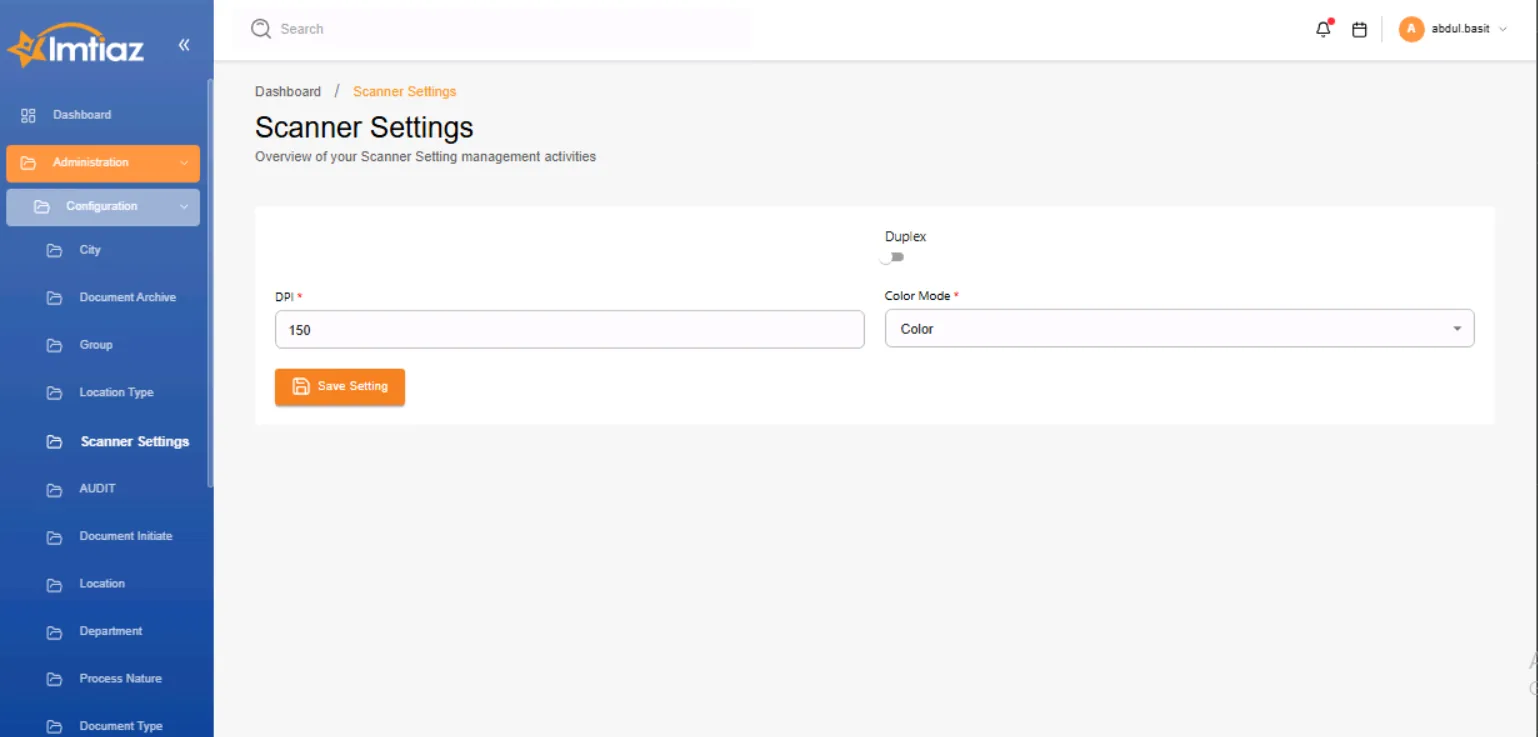
The manual covers PDF indexing and search, document exports, archive views, reporting and audit logs. Scanner settings include capture configuration such as DPI, color mode and duplex selection.
SAP document synchronization is part of the documented application scope. A similar implementation would need to define the exact business records, interfaces and reconciliation responsibilities rather than assume universal SAP compatibility.
Controls and evidence boundaries
User roles, group permissions, company or location setup and audit activity support the operating workflow described in the manual. This case study does not claim a security certification or a measured reduction in processing time.
The selected application image illustrates scanner configuration. The source manual remains a private reference and is not offered as a public download.
A complete document journey
The documented DMS combines the file with its operational references and processing history. Indexing helps users find the material, while note sheets and workflow trails explain how it was handled. Keeping those responsibilities together is more informative than describing the application simply as a shared folder or a scanning utility.
A useful review would initiate a document with supporting material, return it for clarification, then verify the trail and final retrieval. A separate synchronization example should reconcile a SAP-related record with the document reference. Scanner settings show capture configuration; they do not alone establish automatic interpretation or approval of scanned information.
Client application views
Related software and services
Sources and project evidence
Project scope and technologies come from MMC’s supplied project records. Where manuals or application screens are available, they provide the implementation detail. Public sources establish organizational or technology context; design considerations describe review criteria rather than unreported delivery results.
Research reviewed 28 November 2026.