
Explain your business clearly
Structure services, company information and supporting evidence around the questions customers ask before making contact.
MMC · Design, development and ongoing care
Build a website that helps visitors understand your business and take the next step. Work with MMC on business websites, CMS development and redesigns, from content structure to launch and handover.
Karachi-based team · Projects across Pakistan
Start with what visitors need
Define who the site serves, what visitors need to know and how enquiries reach your team. Design, content and development should support that journey together.
Structure services, company information and supporting evidence around the questions customers ask before making contact.
Give content owners a usable editing model, reusable templates and clear responsibilities for keeping information current.
Plan calls, forms and other contact paths with useful feedback and an agreed destination, so website enquiries can be handled consistently.
Design, build and improve
Start a new business website, improve an existing one or plan a migration. Each proposal identifies included deliverables, content responsibilities and dependencies.
Organize your services, company information and enquiry journeys around the people you need to reach. Define reusable page types and the content needed for each.
Plan navigation, wireframes and responsive layouts before development. Review real copy, brand assets and key interactions together so the design works beyond a single polished screen.
Model pages, news, services and media so editors can maintain them. Agree on roles, previews, reusable blocks and training within the chosen CMS.
Inventory existing content and URLs before changing the site. Define what to retain, merge or replace, map redirects and reconcile migrated content before launch.
Connect enquiries, CRM, booking or other agreed services. Define validation, consent needs, spam protection and what happens when a connected service is unavailable.
Assess media, scripts, templates, crawlability and metadata against the actual site. Prioritize measured issues and verify changes without assuming a full rebuild is necessary.
Plan semantic structure, readable contrast, keyboard interaction, focus behavior and useful form feedback. Agree on the accessibility review scope and any conformance target.
Define updates, backups, recovery checks, defect handling and ongoing content or template work. Record hosting ownership, coverage and recurring charges in the proposal.
Choose the right project scope
The requirements overlap, but each needs its own delivery plan. Identify the primary visitor journey before selecting a platform.
Company information, services, news and enquiry pages with an editorial workflow. This page covers website design, CMS development and ongoing improvements.
Discuss a websiteProduct catalogues, checkout, payments and order handling need a dedicated commerce scope. Include fulfilment, inventory and payment-provider dependencies.
Discuss an online storeLogged-in workflows, dashboards and transactional systems require roles, business rules, integrations and a separate application architecture.
Explore software developmentThe brief guides the platform
Compare editorial needs, integrations, hosting and long-term ownership. A familiar CMS may fit one project; a separately managed frontend and CMS may fit another.
A content-managed business site where publishing and familiar editorial tools matter. Review plugins, custom templates, updates and hosting responsibilities before selecting the approach.
A .NET-based CMS option for structured content and custom integrations. MMC’s PCAA and PAA project records include Umbraco with React interfaces and .NET Core APIs.
Consider a React frontend when the site has substantial interaction or connects to application services. Rendering, routing and CMS integration still need explicit design decisions.
Assess Drupal for structured content, editorial roles and connected information services. Confirm module compatibility, content modeling and long-term maintenance requirements.
From MMC’s documented portfolio
These project records describe public websites built with React, Umbraco and .NET Core APIs. Explore the documented scope and discuss which parts are relevant to your requirement.
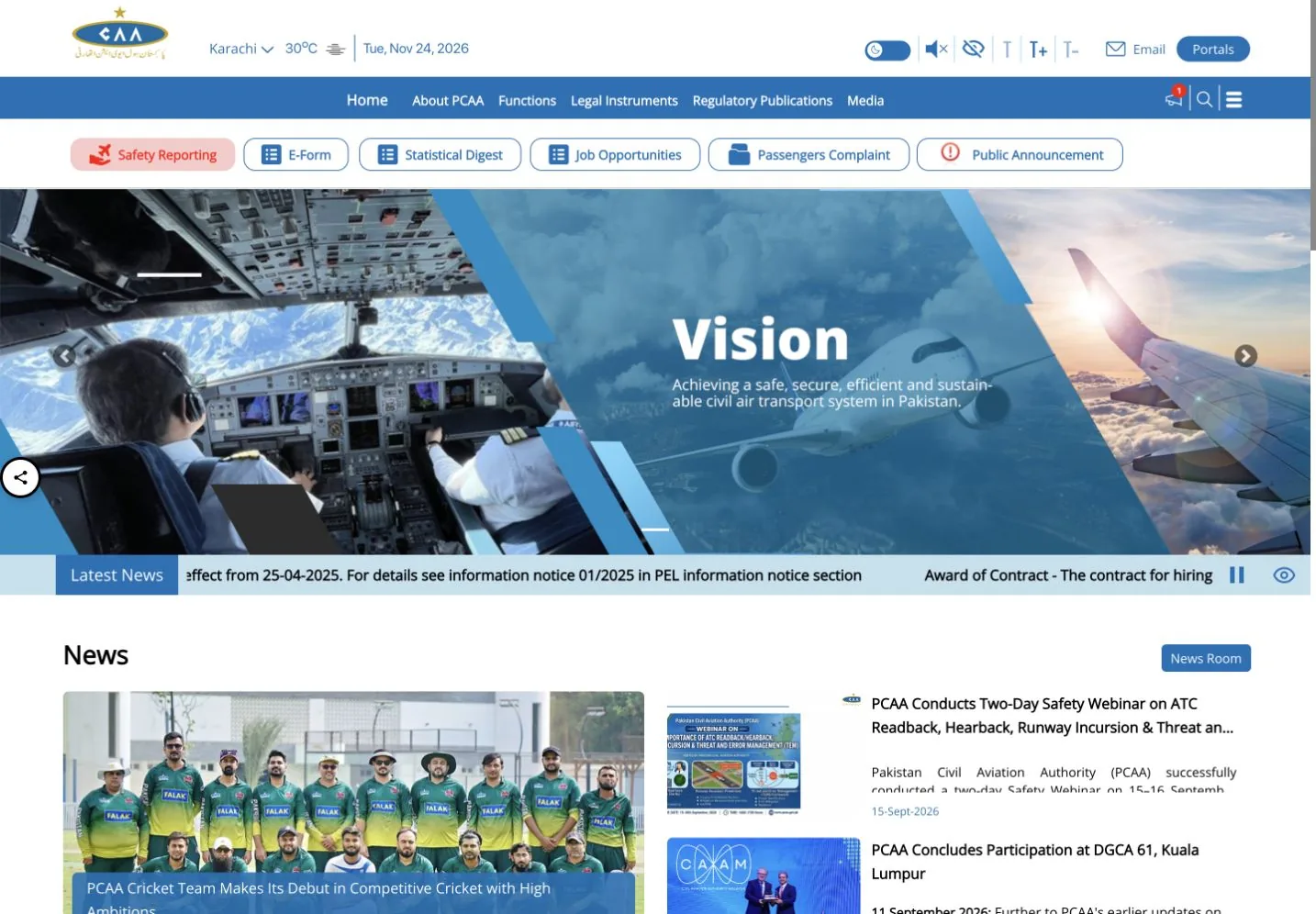
A public regulatory website combining content management, a React frontend, .NET Core APIs and a custom workflow engine.
Read the website case study
An airport information and digital-services platform combining public content, service access, Umbraco and application integrations.
Read the website case studyA website delivery process
Agree on outputs and review responsibilities at each stage. Content preparation and stakeholder decisions belong in the schedule alongside development.
Identify audiences, business goals, existing analytics, content owners and site constraints. Agree on the purpose of a first release and the information still needed.
Map navigation, page families, key messages and enquiry paths. Assign content responsibilities and prepare a URL map where pages are changing.
Review responsive wireframes and visual designs with realistic content. Resolve navigation, accessibility and editing requirements before expanding the build.
Build reusable templates and agreed integrations. Configure editorial roles and demonstrate representative pages as working increments.
Check supported browsers and devices, forms, keyboard journeys, metadata, redirects and content. Agree on acceptance, backups, rollback and release access.
Complete the agreed cutover, verify priority journeys and hand over accounts and documentation. Confirm editor training and the scope of post-launch monitoring and maintenance.
Prepare for real visitors
Set acceptance criteria around important pages and user journeys. Testing scope, supported browsers, accessibility requirements and monitoring responsibilities should be explicit.
Review navigation, page layouts and enquiries at representative phone, tablet and desktop sizes. Test content-heavy pages and error states as well as the homepage.
Set realistic performance budgets and review keyboard access, labels, contrast and focus. Lab measurements inform development; live user data is needed to assess real-world Core Web Vitals.
Use descriptive titles, headings, canonical URLs and crawlable links. Check redirects and sitemaps where needed. Clear content also helps machines understand the page; rankings and AI citations are not guaranteed.
Record domain, hosting, CMS and analytics access. Include backup and restore responsibilities, update ownership, documentation and any support agreement.
Extend your delivery capacity
Need development support for a new site, a redesign or an existing backlog? Share the platform, required skills and expected duration so MMC can review availability and propose a suitable arrangement.
Identify frontend, CMS, integration and maintenance requirements. Share designs or the current website, repository access needs and the outcomes the developer should deliver.
Discuss relevant experience, review steps and onboarding. Record communication, working-hour overlap, code reviews, content handoffs and release responsibilities.
Set the available engagement model, pricing, confidentiality, source-code and account ownership, third-party licences and handover terms before work starts.
Karachi base · Pakistan-wide collaboration
Work with MMC’s Karachi-based team on website design, CMS development and ongoing improvements across Pakistan. Agree on remote workshops and any site visits during planning.
Discuss your business website or hiring brief with MMC’s Karachi team. Include local meeting needs, existing systems and the people responsible for content and approvals.
For a Lahore-based business, share your audience, services, current website and target date. Agree on remote discovery, design reviews and editor training; on-site work is confirmed separately.
Plan your website from Islamabad with clear stakeholder reviews, content responsibilities and integration access. Confirm communication, acceptance milestones and handover with MMC.
A proposal you can compare
The number of URLs alone does not describe the work. Identify reusable templates, content readiness, integrations and operating requirements before comparing estimates.
Define template families, languages, copywriting, media preparation and content entry. Assign responsibilities and review dates so approvals are part of the plan.
List forms, search, CRM or other integrations and the content and URLs that must move. Include access, data cleanup, redirects and launch dependencies.
Separate project delivery from hosting, domains, licences and maintenance. Confirm account ownership, training, post-launch coverage and recurring charges.
Start with an assessment, a defined design-and-build project or a prioritized improvement backlog. MMC confirms pricing and milestones after reviewing the scope and available engagement arrangement.
Before you start
The estimate depends on page templates, design, content, CMS requirements, integrations and migration. Share your current website and intended scope so MMC can propose deliverables and identify recurring costs separately.
Timing depends on scope, content readiness, integrations and review availability. Agree on milestones after discovery, including who supplies copy and images and when approvals are needed.
Yes, a redesign can be assessed after reviewing the current site, content, technology and business goals. Preserve useful URLs and plan redirects for changes, with a launch and rollback plan where required.
Choose around editing needs, functionality, integrations, hosting and maintenance capacity. MMC can discuss WordPress, Umbraco, Drupal or a custom frontend where appropriate, with trade-offs recorded in the proposal.
For a CMS-based site, define the page types and fields editors can change, roles and review steps. Include training and documentation in the scope; custom functionality may still require development.
Agree on copywriting, editing, translation, photography and image licensing during scoping. Identify what the client supplies and what MMC is expected to prepare so content does not become an unplanned dependency.
URL mapping, redirects, metadata and post-launch checks help manage migration risk. Search visibility can fluctuate, so rankings cannot be guaranteed. Review important pages and monitor the live site against a baseline.
These should be listed separately in the proposal. Confirm account ownership, renewals, backups, recovery responsibilities, update work and the exact coverage of any maintenance agreement.
Share the skills, platform, expected duration and preferred collaboration arrangement. MMC can review availability, selection and onboarding requirements, then confirm capacity and engagement terms.
MMC is based in Karachi and can discuss website projects across Pakistan. Agree on remote workshops, stakeholder reviews and any on-site work in the proposal. Offices outside Karachi are not implied.
Agree on custom-code ownership, repository access, domain and hosting accounts, third-party licences and handover before work begins. The project agreement should identify any ongoing dependencies.
Define defect handling, security and dependency updates, content changes, monitoring and incident escalation in the proposal. Confirm support hours, response expectations and recurring charges rather than assuming unlimited maintenance.
Plan with MMC
Share your current URL, goals, content needs and deadline. We can discuss a practical scope for a new build, redesign or improvement project.
Our reach
 Pakistan
 USA
 Australia
 Belgium
 Paraguay
 Denmark
 UK
 Afghanistan
 Philippines
 Turkey
 Thailand
 Canada
 Sweden
 Singapore
 Colombia
 UAE
 New Zealand
 Kyrgyzstan
 France
 Switzerland
 Tanzania
 Uganda
 Tajikistan
 China
 Italy
 Finland
 Qatar
 Zimbabwe
 Saudi Arabia