
Organize the public journey
Bring airport, passenger and institutional information into a navigation structure that reflects what visitors need to do.
Government & aviation · Pakistan
Pakistan Airports Authority
A public-facing aviation platform bringing airport information, passenger guidance and service access together, built with Umbraco, a React frontend, .NET Core APIs and a custom workflow engine.

Airport operations & public services


The project
For an airport authority, the website serves different audiences at once: passengers planning a journey, aviation stakeholders finding services, and teams publishing operational information. The PAA project brings these needs into a shared public-facing platform, supported by a distinct content and application architecture.
The challenge
The design challenge was to make a broad aviation information landscape understandable without treating every visitor as the same audience. A passenger looking for a flight or travel guidance should not have to follow the same route as a stakeholder seeking an operational portal or a business notice.
PAA’s website addresses these audiences through airport information, passenger guidance, flight schedules, news and a dedicated portal directory. The information architecture connects a broad public information service with clearly identifiable routes to specialist destinations.
Design objectives
Bring airport, passenger and institutional information into a navigation structure that reflects what visitors need to do.
Give the platform a CMS foundation for maintaining information independently of the frontend presentation.
Separate public interactions, API services and custom process logic so their responsibilities remain clear.
The solution
The public website acts as a common starting point for airport information and digital service discovery. Its homepage combines a recognizable aviation identity with practical routes into travel information and institutional content. This creates a shared front door while allowing individual journeys to remain distinct.
Umbraco provides the content management foundation, React supplies the visitor-facing interface, and .NET Core APIs form the application service layer. The custom workflow engine is the project’s process component. Together, these technologies distinguish content publishing from user interaction and process execution.

Explore the experience
Airport listings and passenger guidance help organize information around the travel journey. These sections sit alongside institutional information rather than replacing it, allowing different audiences to find an appropriate starting point.
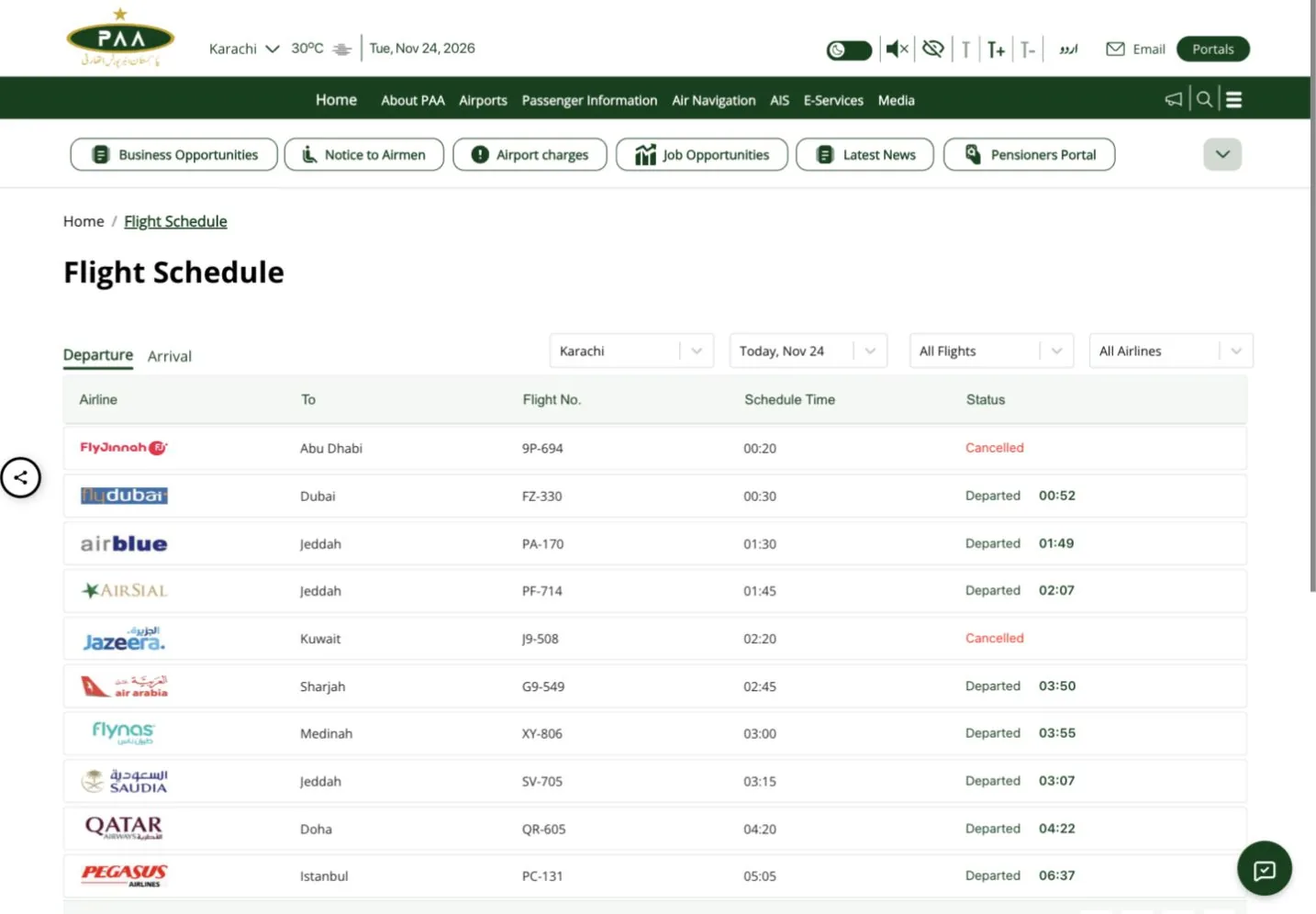
A dedicated flight information view brings departures and arrivals, filters and tabular results into a focused screen. Visitors can identify the relevant flight information without navigating through the wider institutional content.
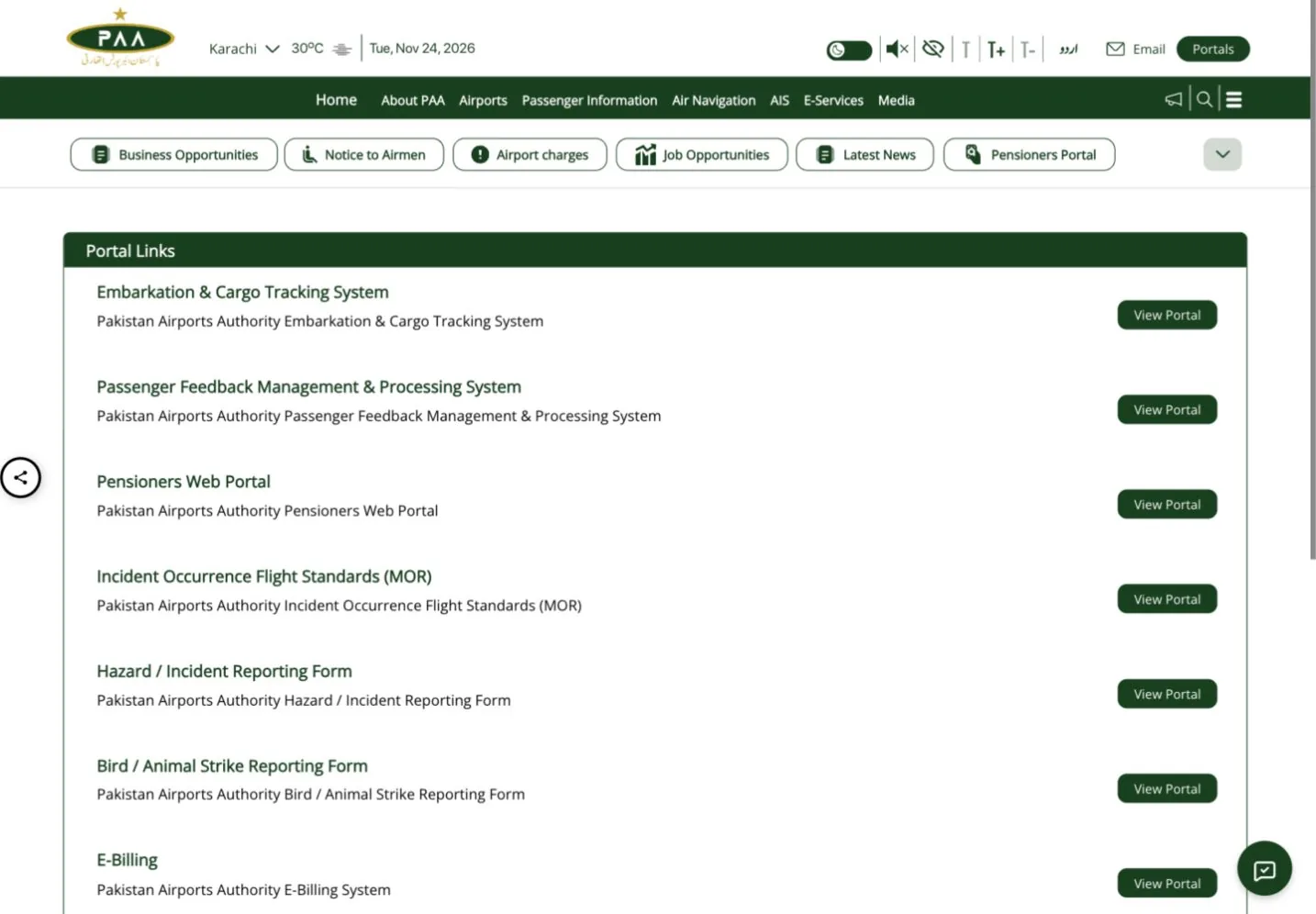
The portal directory groups destinations for passenger feedback, cargo tracking, e-billing and other services. It gives different stakeholders a recognizable starting point for finding the appropriate service.
Technology architecture
The stack combines content management, visitor-facing presentation, application interfaces and a dedicated custom process layer.
Frontend
The public-facing website interface and its visitor journeys.
APIs
The application service boundary connecting interface requests with backend functionality.
Content management
The CMS foundation for managing and delivering website content.
Process logic
A dedicated engine for the project’s custom business workflows.
The custom workflow engine adds an application process layer alongside the CMS and public frontend. This distinction matters because maintaining a page, presenting information and progressing a business process are different responsibilities.
In this architecture, content publishing sits within Umbraco, visitor interactions are presented through React, and application services are exposed through .NET Core APIs. The custom workflow engine has a separate responsibility for business process logic. This keeps the explanation of the system aligned with the purpose of each layer.
Implementation focus
Organize page families, navigation and content responsibilities around airport information and passenger or stakeholder journeys.
Keep the React presentation layer distinct from application services and content management, with explicit boundaries between them.
Keep the custom process engine identifiable within the stack rather than treating every business process as a CMS publishing action.
The result
The platform provides a common public entry point for airport information, passenger guidance, flight information and service destinations. Its combination of content management, frontend presentation, APIs and a custom workflow engine gives the public experience a defined application foundation, while the PAA identity remains consistent across the website.
Project analysis
The public website brings reference information and routes to services into a common institutional experience. Maintaining those destinations requires clear editorial ownership: a visitor should be able to distinguish information published on the website from a specialist service reached through the portal directory.
For a comparable platform, content updates should be reviewed alongside navigation labels, document references and the destination of service links. A directory link provides a route into another system; it should not be interpreted as proof that every linked service shares the website’s internal architecture.
Project analysis
For PAA, useful review journeys include locating an airport, finding passenger guidance and reaching the relevant flight or service destination. Flight information is time-sensitive: a captured screen illustrates the interface, while current operational information must come from the live authoritative service.
The available case material establishes the named technology stack and visible public experience. It does not establish visitor conversion, processing-time reductions, service uptime or the internal behavior of every linked portal. Those outcomes require operational measurements rather than inference from website screenshots.
Research and evidence
The technology stack comes from the supplied project record. Public website screens illustrate information structure and service discovery. Public references provide context; linked specialist portals have their own application boundaries.
Research reviewed .
Build with MMC
Talk to our Karachi team about your audiences, content structure, application services and process requirements.
Our reach
 Pakistan
 USA
 Australia
 Belgium
 Paraguay
 Denmark
 UK
 Afghanistan
 Philippines
 Turkey
 Thailand
 Canada
 Sweden
 Singapore
 Colombia
 UAE
 New Zealand
 Kyrgyzstan
 France
 Switzerland
 Tanzania
 Uganda
 Tajikistan
 China
 Italy
 Finland
 Qatar
 Zimbabwe
 Saudi Arabia